

Henrik Aulbach ist erfahrener Gesundheitsredakteur mit über 10 Jahren Erfahrung, Experte für pflanzliche Wirkstoffe und Kultivierung, Co-Gründer, Buchautor und selbstständiger Fachtexter im Gesundheitswesen seit 2020.
Erfahren Sie hier mehr über diesen Autor.

Hildegard-Medizin: Das Wichtigste im Ueberblick
Unter Hildegard-Medizin werden die Lehren zur Gesundheit zusammengefasst, die die Universalgelehrte Hildegard von Bingen im Mittelalter entwickelte. Darin verfolgt die heute als he...
Unter Hildegard-Medizin werden die Lehren zur Gesundheit zusammengefasst, die die Universalgelehrte Hildegard von Bingen im Mittelalter entwickelte. Darin verfolgt die heute als heilig geltende Äbtissin einen ganzheitlichen Ansatz und widmet sich insbesondere dem physischen und psychischen Gleichgewicht. Die Hildegard-Medizin enthält wichtige Informationen über ausgewogene Ernährung, Krankheiten, ihre Behandlung und die Wirkung von Heilpflanzen.

Hildegards Tipp:
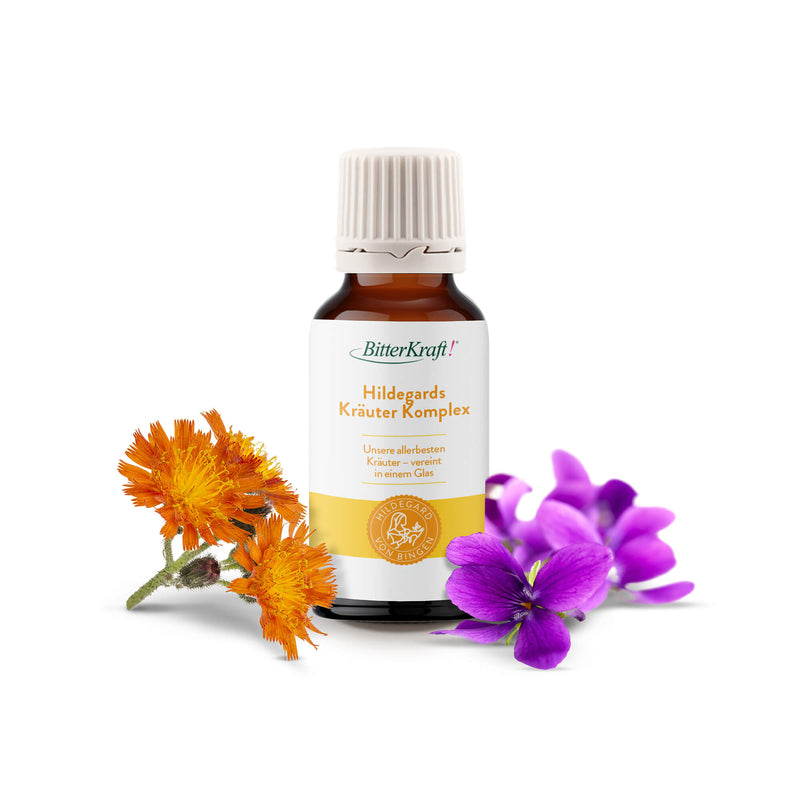
- Milder Kräutergeist mit 5 Hildegard-Heilpflanzen für die Seele
- Rezeptur auf Basis von 800 Jahren Klosterwissen
- Bitterkraft - der Pionier seit 1996 von 4.000 Heilpraktikern verwendet!
- Beste Naturheilkunde: Bio & vegan
Verdienst
Der größte Verdienst der Hildegard-Medizin besteht in der Verbindung von Erkenntnissen über Krankheiten und Heilkräften mit der Volksmedizin. Dabei verwendete die Äbtissin im Gegensatz zu früheren Schriften gebräuchliche deutsche Begriffe und machte das Wissen der Hildegard-Medizin besser nutzbar.
Entstehung
Das Wissen, das wir heute als Hildegard-Medizin bezeichnen, schrieb die Heilige zu ihrer Zeit in ihren beiden Hauptwerken nieder: Causae et curae (Ursachen und Behandlungen) und Liber subtilitatum diversarum naturarum creaturarum (Buch von den Feinheiten der verschiedenen Naturen der Geschöpfe), heute als Physica bekannt.
Im 20. Jahrhundert arbeitete der österreichische Arzt Dr. Gottfried Hertzka die Schriften auf, die Hildegard von Bingen aus dem Mittelalter hinterließ. Bei seiner Tätigkeit als Arzt ließ sich Hertzka von dem mittelalterlichen Wissen leiten und begründete den Begriff Hildegard-Medizin.
Grundpfeiler
Die Hildegard-Medizin basiert auf mehreren Grundpfeiler. Dazu zählen ausgewogene Ernährung, Pflanzenheilkunde, Ausleitungsverfahren und Edelsteintherapie.
Hildegard von Bingen erkannte schon zu ihrer Zeit die große Bedeutung ausgewogener Ernährung für die Gesundheit. Dabei empfiehlt die Hildegard-Medizin Lebensmittel wie Dinkel, Edelkastanie und Fenchel sowie Kräuter und Gewürze.
Die Pflanzenheilkunde nimmt in der Hildegard-Medizin einen wichtigen Stellenwert ein. Die Heilpflanzen ordnete die Äbtissin, je nach ihrem Effekt auf die Gesundheit, in verschiedene Gruppen ein – wärmende, heiße, kalte und neutrale, die zur Behandlung von Krankheiten eingesetzt werden. Das reichhaltige Wissen der Hildegard von Bingen über pflanzliche Arzneimittel machen wir uns heute noch zunutze. Ebenso beschäftigte sich die Heilige in ihren Abhandlungen über die Gesundheit mit Edelsteinen.
Entsprechend ihrer Zeit enthält die Hildegard-Medizin auch Informationen über Ausleitungsverfahren wie dem Aderlass, Schröpfen sowie Fasten und Schwitzbäder.
Ein weiterer Eckpfeiler der Hildegard-Medizin besteht in der Balance zwischen Muße und Arbeit, die einander abwechseln sollen.
Ebenso betonte die Äbtissin den Einfluss von ausreichend Schlaf auf die Gesundheit von Körper, Geist und Seele.
Der Hildegard-Medizin gehören ebenso die spirituellen Erkenntnisse der Heiligen an. Darin betonte Hildegard von Bingen bereits im Mittelalter den Zusammenhang zwischen physischer und psychischer Gesundheit.

Über den Autor Henrik Aulbach
Weitere Artikel
Magenbitterstoffe vor dem Essen: Warum die Reihenfolge entscheidend ist
Magenbitterstoffe vor dem Essen » Nach Hildegard von Bingen ✓ Ohne Zusatzstoffe ✓ Made in Germany – Jetzt mehr erfahren
Bitterstoffreiche Smoothies: Grüne Rezepte für den Verdauungsstart am Morgen
Bitterstoff-Smoothies für den Morgen » Nach Hildegard von Bingen ✓ Vegan ✓ Ohne Zusatzstoffe – Jetzt Rezepte entdecken!
Hildegard von Bingens Dinkelrezepte für eine gesunde Verdauung
Hildegard von Bingens Dinkelrezepte » Nach Hildegard von Bingen ✓ Ohne Zusatzstoffe ✓ Biozertifiziert – Jetzt entdecken