

Viele Frauen kennen das Gefühl kurz vor der Periode: Die Hose sitzt plötzlich enger, die Finger wirken leicht geschwollen, und das Gewicht auf der Waage zeigt ohne erkennbaren Grund ein bis zwei Kilogramm mehr an. Wassereinlagerungen gehören zu den häufigsten Begleiterscheinungen des prämenstruellen Syndroms – und sie können sich nicht nur körperlich, sondern auch auf das allgemeine Wohlbefinden auswirken. Was viele nicht wissen: Die Pflanzenwelt hält seit Jahrhunderten eine Fülle an traditionellen Kräutern und Heilpflanzen bereit, die in der Klostermedizin und Naturheilkunde geschätzt werden, um Frauen in bestimmten Zyklusphasen zu begleiten. Hildegard von Bingen, die große Äbtissin und Naturheilkundlerin des Mittelalters, hinterließ uns ein beeindruckendes Wissen über die weibliche Natur und die Kraft der Pflanzen – ein Wissen, das heute wieder mehr Aufmerksamkeit verdient. Produkte für Frauengesundheit
Was steckt hinter Wasserretention im Zyklus?
Wasserretention, medizinisch auch als Ödem bezeichnet, beschreibt die Ansammlung von Flüssigkeit im Körpergewebe. Im Kontext des prämenstruellen Syndroms tritt dieses Phänomen meist in der sogenannten Lutealphase auf – also in den Tagen zwischen dem Eisprung und dem Beginn der Menstruation. In dieser Zeit verändert sich das hormonelle Gleichgewicht im weiblichen Körper erheblich: Progesteron steigt an, Östrogen schwankt, und der Körper reagiert darauf auf ganz individuelle Weise.
Östrogen kann in bestimmten Zyklusphasen dazu beitragen, dass der Körper mehr Natrium und damit Wasser zurückhält. Gleichzeitig spielt das Hormon Aldosteron eine Rolle, das den Wasser- und Salzhaushalt reguliert. Dieses komplexe hormonelle Zusammenspiel ist vollkommen natürlich – es erklärt aber, warum sich viele Frauen in der zweiten Zyklushälfte spürbar anders fühlen als in der ersten. Das Spannungsgefühl in der Brust, das leichte Aufgedunsensein im Gesicht oder die schweren Beine am Abend sind Signale des Körpers, die ernst genommen werden sollten.
Wassereinlagerungen vor der Periode sind kein Zeichen von Schwäche, sondern eine natürliche Reaktion des weiblichen Körpers auf hormonelle Veränderungen – und sie lassen sich mit den richtigen pflanzlichen Begleitern achtsam unterstützen.
Interessant ist, dass Ernährung, Stresspegel und der allgemeine Lebensstil ebenfalls einen erheblichen Einfluss darauf haben, wie stark diese Wasserretention wahrgenommen wird. Eine salzreiche Ernährung, wenig Bewegung und chronischer Stress können das Körpergefühl in dieser Phase verstärken. Umso wichtiger ist es, einen ganzheitlichen Blick auf den Zyklus zu werfen – und dabei auch die pflanzliche Welt als Begleiterin zu entdecken. Produkte für Frauengesundheit
Hildegards Blick auf den weiblichen Zyklus – ein Erbe aus der Klostermedizin
Hildegard von Bingen (1098–1179) war ihrer Zeit weit voraus. Als Benediktineräbtissin, Mystikerin und Heilkundlerin verfasste sie umfangreiche Werke über Medizin, Naturkunde und das menschliche Wohlbefinden – darunter das „Physica" und „Causae et Curae", in denen sie auch ausführlich auf die weibliche Natur einging. Für Hildegard war der weibliche Körper ein Spiegel des Kosmos: zyklisch, verbunden mit den Mondphasen und tief verwurzelt in der Natur.
„Die Frau trägt in sich das Wasser der Erde, das sich im Rhythmus des Mondes bewegt. Kräuter, die die Säfte ordnen, sind ihr größter Beistand." – Sinngemäß nach Hildegard von Bingen, Causae et Curae (12. Jhd.)
Hildegard unterschied in ihrer Heilkunde zwischen verschiedenen „Säften", die im Körper wirken – ein Konzept, das dem antiken Vier-Säfte-Modell ähnelt, aber durch ihre eigene spirituelle und pflanzenheilkundliche Perspektive bereichert wurde. Wässrige, schwere Säfte, die sich im Körper stauten, sollten durch bestimmte Kräuter und Lebensgewohnheiten wieder in Fluss gebracht werden. Diese Sichtweise ist heute natürlich nicht mehr mit modernen medizinischen Konzepten gleichzusetzen – doch sie offenbart eine tiefe Beobachtungsgabe, die über Jahrhunderte weitergegeben wurde.
Besonders schätzte Hildegard Kräuter wie Schafgarbe, Frauenmantel und Brennnessel für die weibliche Gesundheit. Sie betonte stets, dass die Natur dem Menschen alles bereitstelle, was er für sein Wohlbefinden benötige – man müsse nur lernen, ihre Sprache zu verstehen. Diese Philosophie des „Hinzufügens statt Weglassens" – also das bewusste Einbinden heilsamer Kräuter in den Alltag – ist bis heute ein tragendes Prinzip der Klostermedizin und findet sich im modernen Naturheilkunde-Verständnis wieder. Hildegard von Bingen Produkte
Das Verständnis des weiblichen Zyklus als natürlichen Rhythmus, der Aufmerksamkeit und Fürsorge verdient, ist eines der wertvollsten Vermächtnisse aus Hildegards Werk. Statt Symptome zu bekämpfen, laden ihre Lehren dazu ein, den Körper in seiner natürlichen Dynamik zu begleiten und zu stärken.
Pflanzliche Begleiter bei Wasserretention – was die Naturheilkunde bereithält
Die Natur bietet eine beeindruckende Vielfalt an Pflanzen, die in der tradionellen Pflanzenheilkunde seit Generationen bei zyklischen Beschwerden und Wassereinlagerungen geschätzt werden. Dabei geht es nicht darum, Beschwerden zu behandeln oder zu heilen – sondern darum, den Körper in Phasen erhöhter Belastung mit dem zu versorgen, was er braucht. Das Prinzip der Ergänzung, des Begleitens statt Eingreifens, steht im Vordergrund.
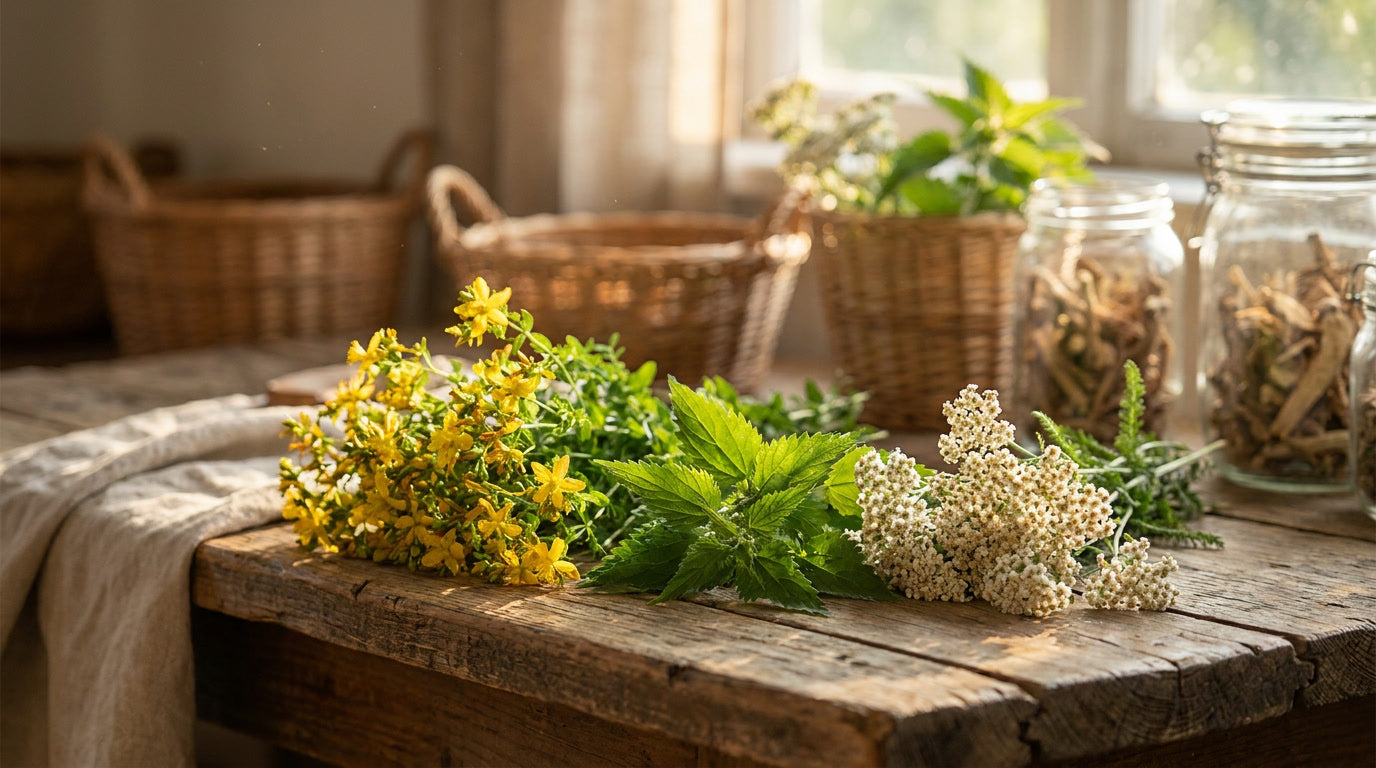
Traditionell verwendete Heilkräuter wie Brennnessel, Frauenmantel und Goldrute werden seit Jahrhunderten in der europäischen Kräutermedizin geschätzt – nicht als Arzneimittel, sondern als pflanzliche Begleiter, die das allgemeine Wohlbefinden in bestimmten Lebensphasen unterstützen können.
Diese Heilkräuter werden traditionell bei zyklischen Wassereinlagerungen geschätzt:
- Brennnessel (Urtica dioica): Die Brennnessel ist eine der am häufigsten verwendeten Heilpflanzen in der europäischen Volksmedizin und wird seit Jahrhunderten traditionell zur Unterstützung des allgemeinen Wohlbefindens genutzt. Hildegard von Bingen erwähnte sie als „reinigende" Pflanze, die die Lebenskraft stärke.
- Frauenmantel (Alchemilla vulgaris): Der Frauenmantel ist wohl die bekannteste Frauenpflanze der Klostermedizin und wird historisch bei allen Beschwerden rund um den weiblichen Zyklus geschätzt. Sein Name verweist bereits auf seine traditionelle Rolle als Begleiterin der Frau durch alle Lebensphasen.
- Echte Goldrute (Solidago virgaurea): In der traditionellen Kräutermedizin wird die Goldrute seit dem Mittelalter verwendet und gilt als Klassiker, wenn es um das allgemeine Wohlbefinden rund um Wasserhaushalt und Ausscheidungsorgane geht. Sie findet sich in vielen historischen Kräuterbüchern.
- Schafgarbe (Achillea millefolium): Hildegard von Bingen nannte die Schafgarbe ein besonders wertvolles Kraut für Frauen und empfahl sie in verschiedenen Zubereitungen. Traditionell wird sie bei zyklischen Ungleichgewichten als pflanzliche Begleiterin eingesetzt.
- Mönchspfeffer (Vitex agnus-castus): Bereits in der Antike bekannt und in der klösterlichen Heilkunde Europas geschätzt, wird Mönchspfeffer traditionell bei Beschwerden im Zusammenhang mit dem weiblichen Zyklus verwendet. Er gehört zu den am besten erforschten Heilpflanzen im Bereich Frauengesundheit.
- Löwenzahn (Taraxacum officinale): Löwenzahn wird in der europäischen Volksmedizin seit Jahrhunderten als vielseitige Pflanze eingesetzt und ist besonders für die Unterstützung des allgemeinen Wohlbefindens bekannt. Traditionell wird er in Tees und als Frühlingskur verwendet.
Was steckt hinter diesen Pflanzen?
Brennnessel enthält unter anderem Flavonoide, Mineralstoffe wie Kalium, Eisen und Kieselsäure sowie Chlorophyll – eine Kombination, die in der Pflanzenheilkunde sehr geschätzt wird. Frauenmantel ist reich an Gerbstoffen und Phytosterinen. Die Goldrute enthält Saponine, Flavonoide und ätherische Öle. Diese Inhaltsstoffe sind Gegenstand zahlreicher botanischer Studien und unterstreichen das jahrhundertealte Interesse der Pflanzenheilkunde an diesen Gewächsen. Keines dieser Mittel ersetzt eine medizinische Beratung – sie sind als ergänzende Begleiter im Sinne einer naturnahen Lebensweise zu verstehen.
Die Form der Zubereitung spielt in der traditionellen Kräutermedizin eine große Rolle. Tees aus frischen oder getrockneten Kräutern, Tinkturen, Kräuterkissen oder die Integration der Pflanzen in die tägliche Ernährung – all das sind Wege, um den pflanzlichen Begleiter in den Alltag zu integrieren. BitterKraft Original
Ganzheitliche Alltagsrituale für ein besseres Zyklusgefühl
Pflanzliche Unterstützung wirkt am besten im Kontext eines bewussten, ganzheitlichen Lebensstils. Das wusste auch Hildegard von Bingen, die stets betonte, dass Kräuter keine isolierten Wundermittel sind, sondern Teil einer größeren Lebensordnung – der sogenannten „Ordo" – die Ernährung, Bewegung, Schlaf und inneres Gleichgewicht umfasst. Ein Tee aus Frauenmantel und Brennnessel kann wunderbar in ein tägliches Morgenritual eingebunden werden; eine Wärmflasche auf dem Bauch in der zweiten Zyklushälfte ist eine bewährte Praxis der Hausmedizin.
Ernährungsseitig empfehlen Naturheilkundler traditionell, in der zweiten Zyklushälfte besonders auf eine ausgewogene Versorgung mit Kalium zu achten – Kalium findet sich reichlich in Bananen, Hülsenfrüchten, Nüssen und vielen Gemüsesorten. Gleichzeitig kann eine bewusste Reduktion von stark verarbeiteten, salzreichen Lebensmitteln das Körpergefühl in der Lutealphase positiv beeinflussen. Auch ausreichend Wasser zu trinken – paradoxerweise hilft Trinken dabei, Wassereinlagerungen zu verringern, da der Körper bei ausreichender Flüssigkeitszufuhr weniger in den „Speichermodus" wechselt. Fasten-Produkte
Eine Übersichtsarbeit im Journal of Women's Health (2016) deutet darauf hin, dass verschiedene pflanzliche Präparate traditionell bei PMS-Beschwerden eingesetzt werden und dass pflanzliches Begleitpotenzial im Bereich zyklischer Beschwerden ein wachsendes Forschungsfeld darstellt. Die Ergebnisse erlauben keine allgemeinen Wirkungsaussagen, unterstreichen jedoch das historisch gewachsene Interesse der Wissenschaft an diesem Bereich.
Sanfte Bewegung wie Yoga, Spaziergänge in der Natur oder leichtes Schwimmen werden in der Naturheilkunde als sinnvolle Begleiter bei zyklischen Beschwerden betrachtet – nicht als Leistungssport, sondern als Einladung, den Körper in Bewegung zu halten und die natürliche Zirkulation zu fördern. Hildegard sprach von der Wichtigkeit der „viriditas" – der grünen, lebendigen Kraft der Natur – die der Mensch in sich spüren solle, indem er sich ihr öffnet. Ein Spaziergang durch Wald und Wiese in der zweiten Zyklushälfte ist in diesem Sinne nicht nur Bewegung, sondern auch Naturmedizin. Schlaf- und Entspannungsprodukte
Ein bewusster Lebensstil, der Kräutertees, ausgewogene Ernährung und sanfte Bewegung miteinander verbindet, kann das allgemeine Wohlbefinden in der zweiten Zyklushälfte auf ganzheitliche Weise begleiten – ganz im Sinne der klösterlichen Lebensordnung Hildegards.
Darüber hinaus lohnt es sich, ein Zyklustagebuch zu führen. Wer über mehrere Monate hinweg notiert, wann Wassereinlagerungen besonders spürbar sind, was gegessen wurde, wie der Stresspegel war und welche Kräuter eingesetzt wurden, bekommt ein feines Gespür für die eigenen Muster. Dieses Wissen ist Gold wert – und es entspricht ganz dem ganzheitlichen Beobachtungsansatz, den Hildegard in ihren Schriften beschreibt. Die Frau als Expertin ihres eigenen Körpers: Das ist eine Botschaft, die aus der Klostermedizin des Mittelalters bis in die Gegenwart trägt. alle Bitterkraft Produkte
Bitterkraft-Empfehlung: So lässt sich pflanzliche Begleitung im Alltag integrieren
Bei Bitterkraft.com glauben wir an die Kraft der Natur – und daran, dass tradiertes Kräuterwissen und modernes Wohlbefindensbewusstsein wunderbar zusammenpassen. Wer die pflanzliche Begleitung im Zyklus ausprobieren möchte, findet bei uns sorgfältig ausgewählte Produkte, die auf bewährten Pflanzenkombinationen basieren und in Anlehnung an das tradierte Wissen der Naturheilkunde entwickelt wurden. Dabei setzen wir auf höchste Qualität bei der Rohstoffauswahl, Transparenz bei den Inhaltsstoffen und einen respektvollen Umgang mit dem Erbe der Klostermedizin.
Unsere Empfehlung für die zweite Zyklushälfte:
Ein täglicher Kräutertee aus Frauenmantel, Brennnessel und Schafgarbe kann als einfaches Morgenritual in den Alltag integriert werden. Wer es praktischer mag, greift zu hochwertigen pflanzlichen Präparaten in Kapselform oder als Tinktur – idealerweise aus zertifizierter Bio-Landwirtschaft und ohne unnötige Zusatzstoffe. Ergänzend empfehlen wir einen Blick in unsere Produkte für Frauengesundheit Produktwelt rund um Frauengesundheit und Zyklus – dort finden sich Kräuterkombinationen, die seit Generationen traditionell verwendet werden.
Der beste Einstieg in die Welt der pflanzlichen Zyklusbegleitung ist oft ein kleiner, aber konsequenter Schritt: ein Tee am Morgen, ein bewusster Spaziergang am Nachmittag, ein frühes Zubettgehen am Abend. Diese Rituale, eingebettet in den natürlichen Rhythmus des weiblichen Zyklus, können das Körpergefühl langfristig bereichern – ohne Aufwand, ohne Nebenwirkungen, dafür mit viel traditionellem Hintergrundwissen. BitterKraft Original
Wer tiefer in das Thema einsteigen möchte, findet auf Bitterkraft.com weiterführende Artikel zur Klostermedizin nach Hildegard von Bingen Hildegard von Bingen Produkte, zu Bitterpflanzen und ihrer historischen Rolle in der Frauengesundheit BitterKraft Original sowie zu ganzheitlichem Wohlbefinden im Alltag alle Bitterkraft Produkte. Denn das Wissen der Jahrhunderte gehört in die Hände derer, die es nutzen möchten – bewusst, informiert und mit tiefer Achtsamkeit für den eigenen Körper.

Hinterlasse einen Kommentar
Diese Website ist durch hCaptcha geschützt und es gelten die allgemeinen Geschäftsbedingungen und Datenschutzbestimmungen von hCaptcha.