





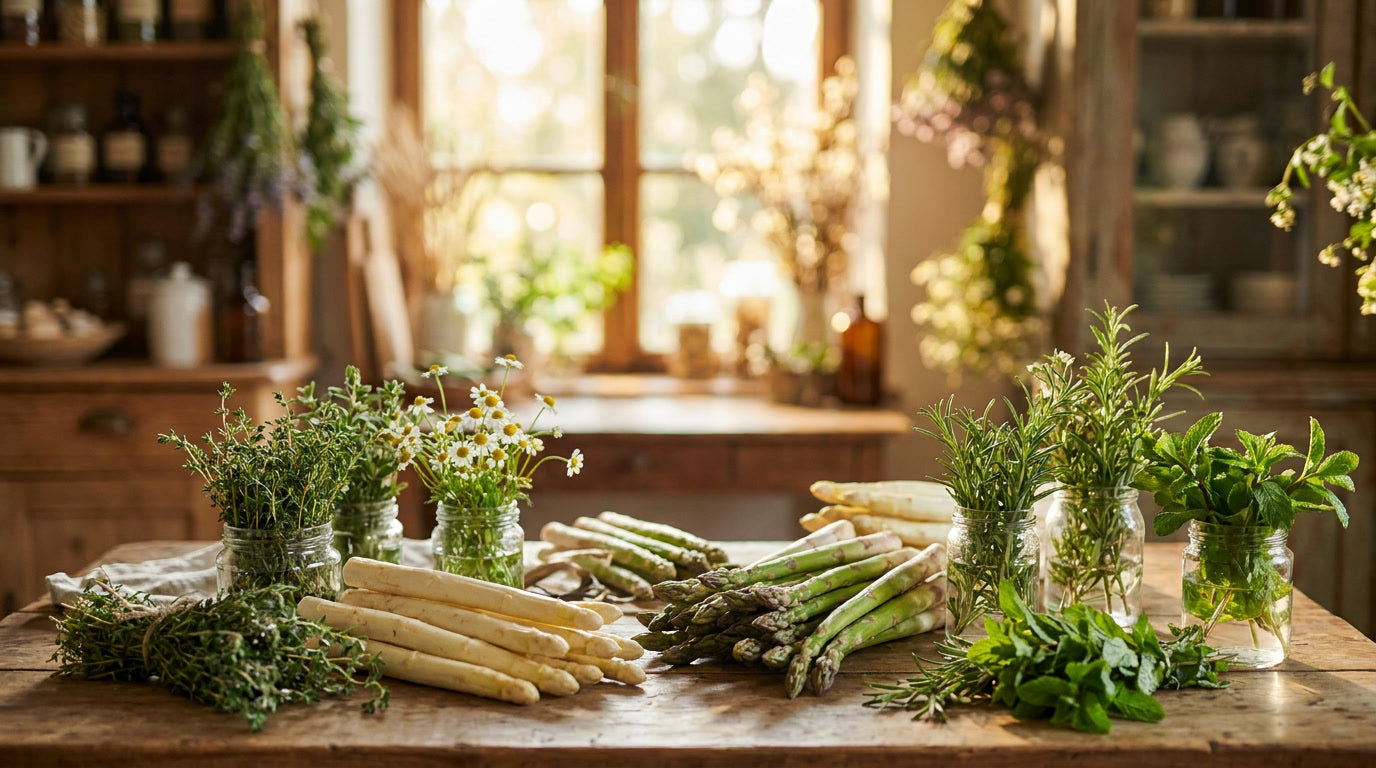
Hardly any vegetable is as closely associated with spring as asparagus. When the first white and green spears flood the markets from April, not only gourmets rejoice – asparagus has also been regarded for centuries in naturopathy and traditional monastic medicine as a special seasonal gift of nature. Its short season, distinctive taste, and traditional use as a revitalizing spring vegetable make it a true cultural asset – far beyond the plate. In this article, we delve into the fascinating history of asparagus as a traditional spring vegetable, explore its connection to Hildegard medicine, and show why this noble vegetable still deserves a firm place in a conscious, nature-oriented lifestyle today.
Asparagus in History: From Antiquity to the Monastery Pharmacy
The history of asparagus as a cultivated plant goes far back – to antiquity. The ancient Egyptians already used the plant, as wall paintings from 3000 BC show. The Greeks and Romans valued asparagus not only as a delicacy but also as a plant with special significance for physical well-being. The Greek physician Dioscorides described the plant in the first century AD in his famous herbal book De Materia Medica – one of the most influential botanical-medical works of antiquity, which was copied and studied in European monasteries for centuries afterward.
In the Middle Ages, knowledge of medicinal plants found its safest refuge in monastery gardens. Benedictine, Cistercian, and Augustinian monks and nuns tended their herb gardens with great care, preserving knowledge passed down partly orally and partly in writing through the centuries. Asparagus (Asparagus officinalis) was a fixed component of these gardens – not least because it is a perennial shrub that, once planted, yields harvests for many years, making it ideal for self-sufficient monastic communities. In monastery chronicles and herbals of the time, it regularly appears as a spring vegetable meant to revive the organism after the lean winter.
Particularly interesting is asparagus’s role in the broader context of the monastic annual rhythm. The fasting period before Easter was in monasteries not only a spiritual but also a physical renewal time. After weeks of abstinence and simple fare, the appearance of the first asparagus spears was a welcome sign of spring – a signal that the earth was fertile again and the body could be strengthened. This rhythm of fasting, emptying, and renewing spring nourishment is deeply rooted in European monastic culture and still resonates in naturopathic spring concepts today. Fasting products
Already in the Middle Ages, monastery chronicles and botanical collections recorded asparagus as one of the first and most important spring plants in the monastery garden. The botanist and monastic scholar Albertus Magnus mentioned Asparagus in the 13th century in his extensive work De Vegetabilibus as a plant of special benefit for spring.
Hildegard of Bingen and the Knowledge of Seasonal Vegetables
When it comes to monastic medicine and plant knowledge, Hildegard of Bingen is indispensable. The Benedictine abbess, mystic, and universal scholar of the 12th century left behind with her works Physica and Causae et Curae a fascinating testimony of medieval healing arts that still inspires today. Hildegard viewed health as a balance of inner forces and external, seasonal influences – a holistic approach that remarkably anticipates more modern naturopathic concepts. Hildegard of Bingen products
In Hildegard medicine, spring plays a special role. After the long winter, during which the body, according to Hildegard, consumed heavy, dense foods and experienced little movement, spring was the time to shake off this “winter heaviness” and renew the body. Hildegard emphasized in her writings the importance of light, fresh, and bitter-tasting spring foods to restore natural balance. Asparagus – light, water-rich, with a fine bitter undertone – fits perfectly into this concept of a seasonal spring cure according to monastic tradition.
Hildegard herself mentioned asparagus in the Physica and described it as a vegetable that is naturally moist and light and beneficial to the body in spring. Her description focuses less on individual ingredients – that was not a medieval way of thinking – but rather on the energetic quality of the plant: its fresh, slightly bitter nature makes it a suitable food for the season of awakening and renewal. This thinking in qualities, seasons, and elements is characteristic of Hildegard medicine and shows how far this ancient knowledge goes beyond purely empirical herbalism. BitterKraft Original
“Asparagus is warm and dry, and whoever eats it is light in the stomach and healthy.” – Paraphrased from Hildegard of Bingen’s Physica, 12th century. This and similar statements by the abbess are still cited in Hildegard medicine today as historical references for the traditional use of asparagus in spring.
Hildegard of Bingen recommended seasonal spring vegetables like asparagus as part of a holistic renewal concept that should harmonize body, mind, and seasons – a notion that remains alive in modern naturopathy.
What’s in Asparagus? Ingredients and Their Traditional Significance
Asparagus is an exceptionally water-rich vegetable – up to 93 percent of its weight consists of water. Yet what it contains is remarkably diverse despite this apparent lightness. The traditional attribution as a “diuretic” spring vegetable is rooted not only in tradition but also in concrete botanical properties observed and described by generations of herbalists.
What’s in Asparagus?
Asparagine: The namesake amino acid of asparagus – asparagine (Asparagus) is found in no other vegetable as concentrated as in asparagus. Historically, it was credited with asparagus’s diuretic quality. Asparagine naturally contributes to the typical asparagus aroma and characteristic smell.
Saponins: Asparagus contains natural saponins, plant secondary compounds long known in folk medicine that contribute to its characteristic slightly bitter taste.
Flavonoids (Rutin): Rutin is a plant compound with a long history in traditional herbalism and is especially abundant in green asparagus.
Vitamins and Minerals: Asparagus provides folic acid, vitamin C, vitamin K, and potassium – all substances that can contribute to a balanced spring diet.
Fiber (Inulin): As a natural prebiotic, inulin is discussed in modern naturopathy in connection with a healthy gut flora. Gut and digestion products
The traditional use of asparagus as a spring diuretic is closely linked to its natural composition. In Central European folk medicine since the Middle Ages, asparagus has been described as a plant that “waters” – meaning it stimulates excretion through the kidneys. This image of asparagus as a cleansing, water-promoting vegetable appears in herbals of the 16th and 17th centuries as well as in the oral tradition of rural home remedies. Hieronymus Bock described asparagus in his “Kreütter Buch” (1539) as a plant that helps the body get rid of excess – a formulation that still holds true in the sense of traditional use today.
Interesting is the comparison between white and green asparagus. White asparagus – the classic spring vegetable in Germany – grows underground and does not develop chlorophyll. Green asparagus grows above ground and contains significantly more chlorophyll, rutin, and vitamin C. In traditional monastic medicine, it was especially the wild or semi-wild asparagus (Asparagus officinalis in its more original form) found in nature that was considered particularly valuable – an indication that the full plant potential of asparagus may be closely linked to its sun exposure and natural growth.
Asparagus as Part of a Conscious Spring Routine
The concept of a seasonal spring routine – that is, the deliberate focus on certain fresh, invigorating foods and herbs after winter – is one of the oldest practices in European naturopathy. In monastic medicine, this idea was firmly established: the rhythm of nature should be reflected in the rhythm of life. What the earth produces in spring, the belief went, is exactly what the body needs at that time. Fasting products
Asparagus is one of the first fresh seasonal vegetables of the year and was part of a holistic spring diet in monastic medicine, tailored to the body’s natural need for renewal after winter.
How can this tradition be practically integrated into everyday life? Quite simply: by consciously enjoying fresh asparagus during its short season from April to the end of June – preferably from regional and seasonal cultivation. In Hildegard medicine, asparagus is best eaten lightly steamed or cooked in clear broth to preserve its properties as much as possible. Heavy sauces – such as large amounts of butter or rich hollandaise – were used sparingly in monastic tradition because they counteract the lightness of the vegetable. Instead, preparation with mild herbs like parsley, chervil, or lovage was recommended – all classic spring herbs of monastery gardens.
Complementing asparagus, naturopathy and monastic medicine offer a whole range of other traditional plants that have been valued in spring for centuries and can support seasonal well-being. Consciously combining these spring plants – whether as vegetables, teas, or supplements – is a form of “adding rather than subtracting”: no deprivation, no deficiency, but a targeted enrichment of everyday life with what nature has to offer seasonally.
Traditional Spring Plants from Monastic Medicine:
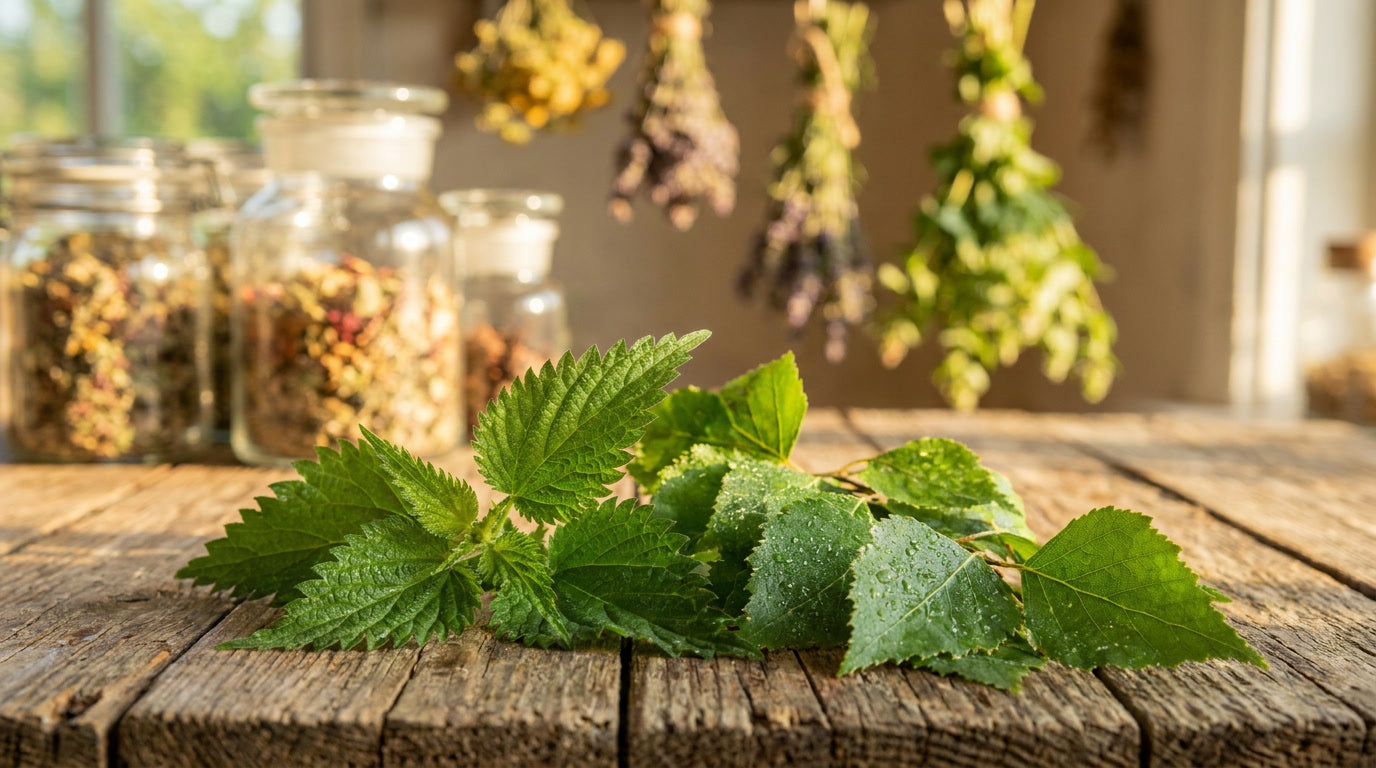
- Nettle: One of the best-known spring and fasting herbs of monastic medicine – known in folk tradition for centuries as a traditional spring herb. Hildegard of Bingen mentioned nettle as one of the most important plants of spring.
- Dandelion: With its bitter leaves and bright yellow flowers, dandelion is traditionally considered one of the first and most important bitter herbs of spring. It has been valued as a spring plant in monastic medicine for centuries. BitterKraft Original
- Wild garlic: The “wild garlic herb” of monastery gardens is a classic spring herb known in Central European folk medicine since the Middle Ages and today regarded as a valued seasonal food.
- Artichoke: Cultivated already in medieval monastery gardens, artichoke with its bitter compounds is considered a classic spring plant of naturopathy. Liver products from Bitterkraft
- Parsley: A staple of every monastery garden – parsley was explicitly mentioned by Hildegard of Bingen and is among the traditional spring herbs of European folk medicine.
The idea of consciously using spring as a time of renewal is deeply rooted in naturopathy. A spring diet rich in asparagus can be wonderfully combined with other traditional elements: a spring tea made from monastery herbs, the deliberate inclusion of bitter vegetables and herbs in the diet, and a general turn toward light, fresh, seasonal fare. This approach is not a diet or a medical program – it is a way of life rooted in centuries of lived experience. Hildegard of Bingen products
The asparagus season from April to the end of June is, according to monastic tradition, one of the most precious spring phases for a conscious, seasonal diet – traditionally associated with renewal, lightness, and the rhythm of nature.
Asparagus Today: Between Enjoyment, Tradition, and Conscious Lifestyle
The knowledge of monastic medicine is experiencing a true renaissance today. More and more people are seeking alternatives to a health understanding based solely on diagnoses and medications and are rediscovering the depth and wisdom of traditional naturopathy. Asparagus is a wonderful example of how traditional plant knowledge and a modern, nature-conscious lifestyle can grow together: a food that tastes good, has a story, and can play a meaningful role in a conscious spring routine – without promises, without exaggeration, but with genuine cultural depth.
In today’s naturopathy, asparagus is primarily recommended as part of a seasonal nutrition concept. Nutritional therapists, naturopaths, and consultants working according to the Hildegard concept appreciate it as a seasonal vegetable to be consciously and abundantly enjoyed during the short spring phase. The traditional attribution as a diuretic, light, and renewing spring vegetable is not understood as a medical claim but as part of a holistic life wisdom: giving the body what the season brings and living in harmony with nature’s rhythm. all Bitterkraft products
Those who integrate asparagus into their daily life in this sense do well to pay attention to quality: fresh, regional asparagus from nature-oriented cultivation not only tastes best but also preserves what generations of herbalists have valued in it. Whether white or green, as soup, steamed, or raw in salad – fresh asparagus is one of nature’s simplest yet most fascinating spring gifts. Monastic medicine has known this for centuries. It is time to bring this knowledge back into our everyday lives.


Leave a comment
This site is protected by hCaptcha and the hCaptcha Privacy Policy and Terms of Service apply.