





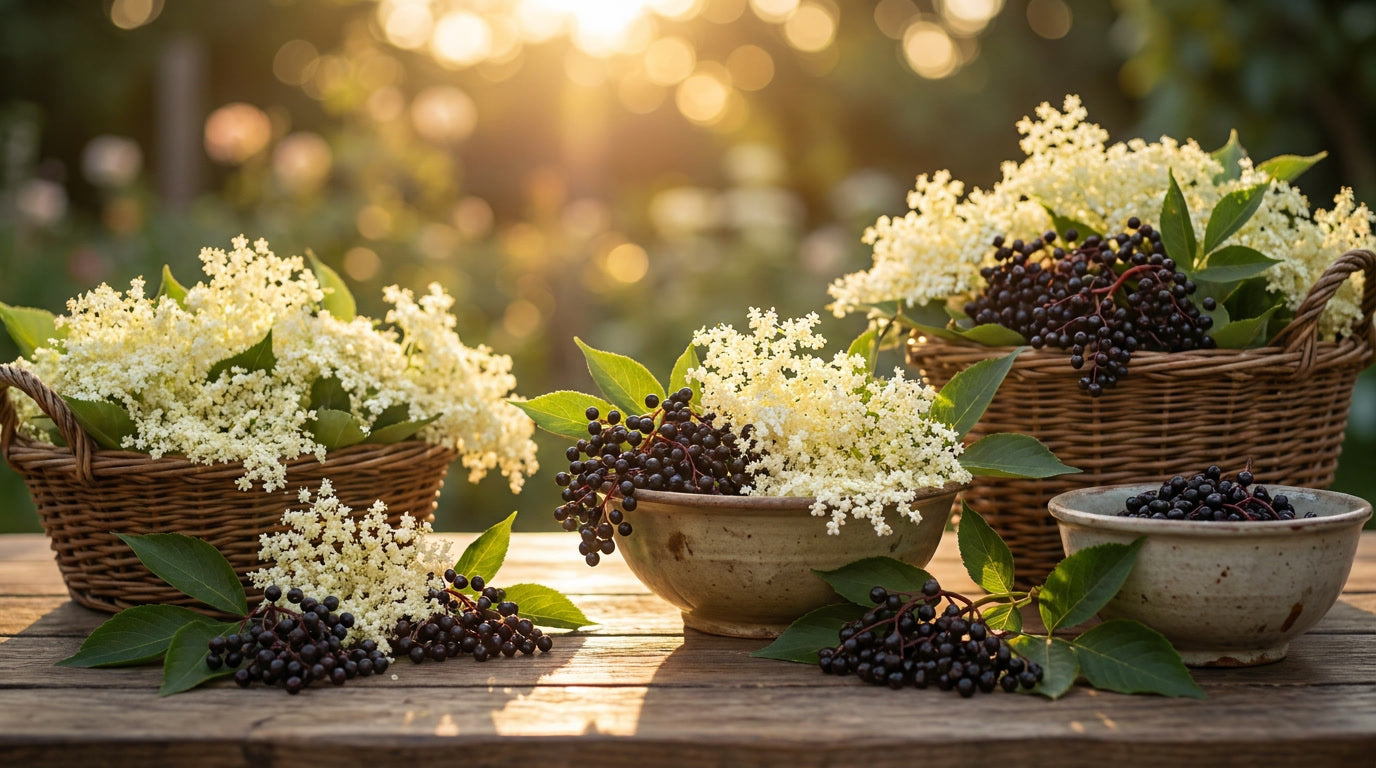
Hardly any plant is as deeply rooted in European herbal knowledge as the black elderberry (Sambucus nigra). Whether as a fragrant flower syrup in early summer or as a dark purple berry juice in autumn – elderberry has accompanied people in Central Europe for centuries. In folk medicine, monastic medicine, and home gardens, it was considered an indispensable companion through the cold seasons. Those familiar with the traditional use of this plant quickly understand why it still holds a firm place in naturopathic practice today.
Elderberry in History: From Hildegard to the Home Pharmacy
The history of elderberry as a medicinal plant goes far back. Already in antiquity, Dioscorides and Hippocrates described the plant and its applications. In the German-speaking region, elderberry became a fixed part of herbal medicine by the Middle Ages at the latest. Hildegard of Bingen, the great universal scholar and abbess of the 12th century, mentioned elderberry in her natural history writings and valued it as part of the divine order of creation given to humans for the care of their well-being.
Hildegard of Bingen wrote in her work Physica about the power of plants: She regarded nature as a living pharmacy, in which every plant has its specific place and significance for human health. Elderberry was considered by her as a plant with a special effect on the “moisture” of the body – a concept deeply rooted in medieval humoral pathology.
In popular belief, the elderberry bush was surrounded by a special mystique. It was often planted near the house to ward off evil spirits and was attributed protective powers. This symbolic charge shows how intuitively connected people were with the plant. The “Holler” or “Flieder” – as it is also called regionally – was much more than a medicinal plant: it was a cultural companion, a sign of village community, and an inseparable part of the seasonal rhythm. Hildegard of Bingen products
The transmission of elderberry knowledge from generation to generation impressively shows how important traditional herbal knowledge was for daily life. Grandmothers knew the exact time windows for harvesting the flowers – just before full opening, when the scent is most intense. And they knew that the berries only become fully ripe and digestible after the first frost. This lived knowledge still forms the basis for the naturopathic use of elderberry today.
What’s in Elderberry? An Overview of the Most Important Ingredients
The traditional appreciation of elderberry has also sparked interest in botany and natural sciences in recent decades. Both the white flower clusters and the small black-purple berries contain a variety of ingredients that have long been known and valued in naturopathy. The interplay of these substances makes elderberry a particularly interesting component of a nature-close lifestyle.
The most important ingredients of black elderberry:
Elderflowers contain essential oils (including linalool and hotrienol), which are responsible for the characteristic scent. In addition, flavonoids such as rutin and quercetin, traditionally known in naturopathy, are found. Mucilages, organic acids, and minerals complete the ingredient profile of the flowers.
Elderberries stand out due to a particularly high content of anthocyanins – the deep purple plant pigments responsible for the intense color of the fruits. Additionally, they contain vitamin C, flavonoids, tannins, amino acids, as well as various sugars and fruit acids. Especially noteworthy are the sambucines, which occur exclusively in elderberry and give it its unique botanical character.
The anthocyanins of elderberries are among the best-researched plant pigments overall. They not only give the berry its characteristic color but are also the subject of numerous botanical and ethnopharmacological studies. In traditional use, the berries were always used in processed form – as juice, syrup, jelly, or puree – since raw, unripe fruits contain certain compounds that are only broken down by heating. Immune system products
The elderflowers, on the other hand, can traditionally also be used fresh, for example as edible decoration or in tea blends. Their mild, floral-sweet aroma makes them a pleasant companion in seasonal herbal teas. In monastic medicine, elderflower teas were traditionally drunk during the transitional seasons of spring and autumn – those times of year when the immune system is particularly challenged.
Elderberry and the Respiratory Tract: A Centuries-Old Tradition
When it comes to the traditional use of elderberry, the respiratory tract has always been the focus. In European folk medicine, elderflower tea was mainly consumed in the cold season when cold weather and harsh air strain the upper respiratory tract. This tradition is so deeply rooted that it is known in almost all German-speaking countries – from Bavaria through Austria to Switzerland. Sleep and relaxation products
Elderberry has been regarded for centuries as one of the most important plants in European folk medicine for respiratory health during the cold season – a tradition that spans from monastery gardens through rural home pharmacies to modern naturopathy.
In traditional use, elderflower tea was drunk warm and lightly sweetened to support general well-being during the transitional seasons. The soothing warmth of the tea combined with the gentle scent of the essential oils creates a feeling of comfort and care – aspects that play a role in holistic naturopathy. Hildegard of Bingen always emphasized the importance of the pleasant: a remedy that one enjoys taking can promote well-being simply through the ritual of its preparation.
Historical herbal books such as Hieronymus Bock’s Kräuterbuch (1539) and Valerius Cordus’s Dispensatorium describe elderberry in detail and recommend it for caring for the respiratory tract in the cold season. These traditions impressively demonstrate how continuous the use of this plant has been in European medical tradition.
Even in modern naturopathy, elderberry is gladly used in combination with other traditional medicinal plants for respiratory health. The combination of elderflowers, thyme, and plantain, for example, is a classic tea blend known in naturopathic practice for generations. It exemplifies the principle of naturopathy: not a single active ingredient, but the harmonious interplay of many plant powers.
Elderberry and the Immune System: Traditional Knowledge and Modern Naturopathy
The use of elderberry to support the immune system during the cold season is one of the oldest and most enduring traditions of European herbal medicine. Especially the dark berries of black elderberry were early regarded in folk medicine as “food for the defenses” – long before it was understood which ingredients might be behind this effect. The instinctive knowledge of people about the power of this plant is remarkable.
Elderberries are among the most anthocyanin-rich fruits in Europe – their deep purple pigment is a sign of a particularly high content of secondary plant substances, which are considered valuable companions for the immune season in naturopathic tradition.
Elderberry extracts and juices are a traditional supplement to autumn nutrition – part of European herbal culture in the dark season for centuries. This corresponds to the traditional principle of the “annual cycle” in naturopathy: nature provides exactly what the human wants to consume in the respective season. Fasting products
These natural remedies are traditionally used to support during cold season:
- Elderberry (Sambucus nigra): Traditionally used for centuries as an anthocyanin-rich fruit to accompany the cold season. Used in folk medicine as juice or syrup.
- Rosehip (Rosa canina): Historically known as a vitamin- and tannin-rich autumn fruit, valued in monastic and folk medicine for the transitional season.
- Ginger (Zingiber officinale): Known in Ayurvedic tradition and European monastic medicine for centuries as a warming spice and tea ingredient in the cold season.
- Echinacea (coneflower): Originating from North American folk medicine, today also traditionally used in European naturopathy to support the cold season.
- Thyme (Thymus vulgaris): A classic monastic herb mentioned in Hildegard’s writings and traditionally used in teas and herbal blends for the respiratory tract.
Those interested in the immune system from a naturopathic perspective can find further valuable information on complementary plant substances and traditional uses at immune system products. The combination of various medicinal plants corresponds to the holistic approach of naturopathy, where the interplay of forces is central – not the isolated substance.
Using Elderflowers and Elderberries: Practical Naturopathy
The practical use of elderflowers and elderberries is pleasantly uncomplicated and can be wonderfully integrated into everyday life. The flowers are traditionally used as tea, syrup, or as part of herbal tinctures. A simple elderflower tea can be prepared by briefly pouring hot water over dried flower clusters – let steep for five to ten minutes, then strain and sweeten with a little honey if desired. This tea is excellent as a soothing evening drink during cold season.
The berries are preferably used in the form of juice, syrup, or concentrated extracts. Freshly pressed elderberry juice is a delicious autumn supplement but should always be heated to break down certain natural compounds in the raw berry. Those who shy away from preparation or want to rely on elderberry power year-round can find a wide range of high-quality ready-made products in health food stores and pharmacies today – from standardized extracts to organic elderberry juices. all Bitterkraft products
Traditional preparation methods at a glance:
🌸 Elderflower tea: Pour 1–2 teaspoons of dried flowers with 200 ml hot water, steep for 8 minutes, strain. Traditionally drunk warm during cold season.
🫐 Elderberry juice: Traditionally made from ripe, heated berries. As a hot drink with cinnamon and cloves, a soothing winter specialty.
🍯 Elderflower syrup: The classic summer preparation – flower clusters macerated with sugar, water, and lemon and processed into an aromatic syrup. Ideal for diluting teas or water.
💊 Elderberry extract (capsules/drops): Concentrated forms for practical daily use, especially popular in autumn and winter months.
When choosing elderberry products, it is worth paying attention to quality and origin. Organic-certified products from controlled cultivation guarantee that the plants have grown without harmful substances and can unfold their full natural power. Particularly valuable are products that process both flowers and berries – because traditional naturopathy uses the whole plant for a holistic effect. Those interested in the connection of elderberry with other herbs of monastic medicine will find further inspiration at Hildegard of Bingen products.
Elderberry in the Annual Cycle: Seasonal Rituals for More Well-Being
One of the most beautiful qualities of elderberry is its close connection to the natural annual cycle. In early summer – usually between May and July – the shrub shows its white flower clusters and fills the air with its characteristic scent. This time is traditionally used in folk medicine for harvesting and processing the flowers. In autumn, when the days become shorter and cooler, the small black-purple berries ripen and invite harvesting.
Elderberry follows a perfect seasonal rhythm: flowers in early summer for light, aromatic teas and syrups – berries in autumn as an intense, colorful ingredient for juices and extracts to prepare for cold season. Nature provides exactly what the body needs at the right time.
This seasonal awareness is a core principle of naturopathy and monastic medicine: humans as part of nature should live in harmony with its rhythms. Conscious harvesting and processing of medicinal plants at their respective ripening time is not only practical but also a meaningful ritual that sharpens the mind for what is essential. Hildegard of Bingen emphasized in her concept of Viriditas – the divine greening power – the living connection between humans, plants, and creation. Hildegard of Bingen products
Those without their own elderberry bush in the garden can harvest elderflowers and berries in many regions of Germany, Austria, and Switzerland in summer and autumn in the wild – elderberry is widespread in hedges, forest edges, and along paths. Care should be taken to choose plants away from heavily trafficked roads and agricultural spraying areas. Those who do not feel confident harvesting or value assured quality can rely on high-quality natural products from specialist retailers – combining practical city life with the spirit of the old herbal tradition.
In conclusion, elderberry is more than a medicinal plant. It is a symbol of the living knowledge of European naturopathy, passed down from Hildegard of Bingen through village herbal women to modern natural pharmacies. Those who consciously integrate elderflowers and berries into their daily life connect to this rich tradition – and complement their nature-close lifestyle with one of the most enduring plants in our cultural history. Immune system products
Note: Dietary supplements are not a substitute for a balanced, varied diet and a healthy lifestyle. In case of health complaints, we recommend seeking medical advice.


Leave a comment
This site is protected by hCaptcha and the hCaptcha Privacy Policy and Terms of Service apply.