





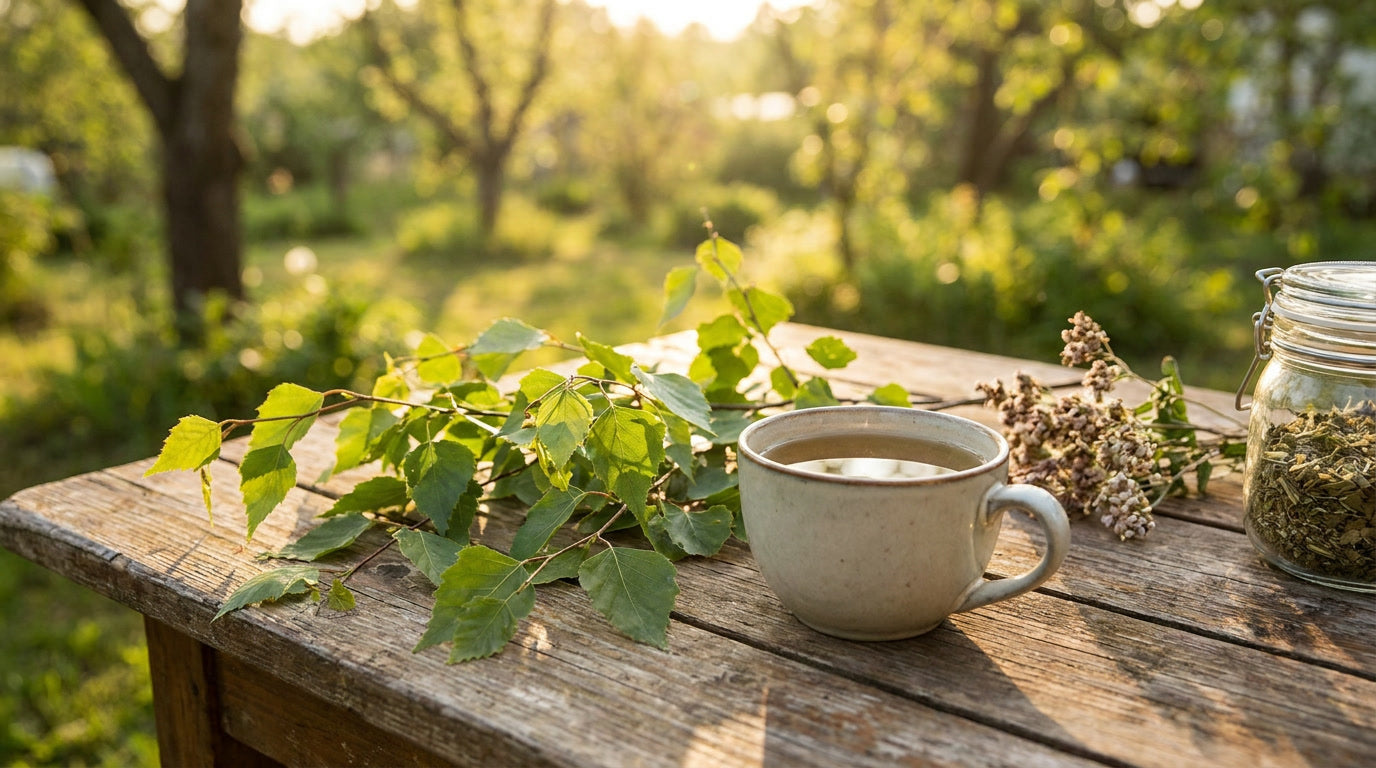
Who doesn’t know it: waking up in the morning with fingers feeling swollen, legs heavy, face slightly puffy – even though you haven’t done anything “bad.” Often, it’s simply due to excessive salt consumption the day before. Salt is essential for life, but in modern diets, most people consume multiples of the recommended amount—hidden in processed foods, cheese, bread, and sausage. What follows is well known to the body: it binds water to dilute the mineral and restore balance. The result is water retention, which feels uncomfortable and noticeably affects well-being. The good news: nature has provided an impressive home pharmacy for centuries, traditionally used to help the body manage this balance. Hildegard of Bingen and other monastic healers already knew which herbs could play a special role.
Why Salt Binds Water in the Body – and What That Means
Sodium is one of the most important electrolytes in the human body. It regulates fluid balance between cells and tissues and is involved in nerve signal transmission. This sounds neutral at first—and it is, as long as the amount is right. The problem arises when more sodium is consumed than the body can process and excrete over time. Sodium attracts water: the more salt present in the tissue, the more fluid accumulates there to dilute the salt concentration. This principle of osmosis is basic biology—and at the same time the direct cause of annoying water retention.
The World Health Organization recommends a maximum of five grams of salt daily for adults. Studies from German-speaking countries show, however, that actual average consumption often doubles or exceeds this amount. Particularly tricky: consciously avoiding adding salt is not enough to be safe. An estimated 70 to 80 percent of daily salt intake comes from processed foods. Ready-made sauces, frozen pizzas, sausages, certain cheeses, and even muesli or bread can contain significant amounts of sodium—often without it being obvious at first glance.
The consequences of a permanently elevated salt level manifest in various ways. Swelling of ankles, legs, or face are the most noticeable signs. This is accompanied by a feeling of heaviness, occasional head tension, and the subjective sensation of being “bloated.” Digestive and gut products In the long term, a salt-rich diet can strain the internal balance—a reason why traditional herbal medicine early on sought ways to support the body’s natural regulatory ability.
The human body actively binds water in the tissues with increased salt intake—a natural protective mechanism that becomes problematic with chronic salt overload. Traditional herbs have been used for centuries to support the body in maintaining its natural balance.
Hildegard’s Herbal Knowledge: What Monastic Medicine Knew About Fluid Balance
Hildegard of Bingen (1098–1179) is considered one of the most important natural healers of the Middle Ages. In her works “Physica” and “Causae et Curae,” she described in detail the properties of plants, minerals, and foods—with a precision that still amazes today. Hildegard spoke of “Viriditas,” the green life force of plants that helps humans find inner balance. Particularly interesting: she made a clear distinction between herbs she classified as “warm and dry” or “cool and moist”—a classification surprisingly close to the concept of water balance in the body.
“What is warm and dry drives the excess out of the person, what is cold and moist holds it in.” – Hildegard of Bingen, Causae et Curae (loosely translated)
For fluid balance, monastic medicine especially recommended herbs traditionally considered “diuretic” or “cleansing.” Hildegard of Bingen products Nettle, lovage, and parsley were among the most frequently mentioned plants in medieval monastery gardens explicitly linked to fluid regulation. The nuns and monks prepared herbal teas, compresses, and simple dishes—not as medicine in the modern sense, but as part of a holistic lifestyle combining nutrition, movement, and spiritual practice.
What distinguishes monastic medicine is its approach of “adding instead of omitting.” Instead of simply reducing salt, herbs were actively sought that give something to the body—an idea increasingly recognized again in modern naturopathy. The plant is not seen as a substitute but as a companion: it complements daily life, enriches the kitchen with flavors, and can support overall well-being. This idea fits seamlessly into the concept of a conscious, natural lifestyle.
Hildegard of Bingen distinguished plants by their “quality”—warm or cool, dry or moist. This ancient classification system reflects a deep understanding of bodily balance and remains an inspiration for naturopathy today.
These Herbs Are Traditionally Used to Support Fluid Balance
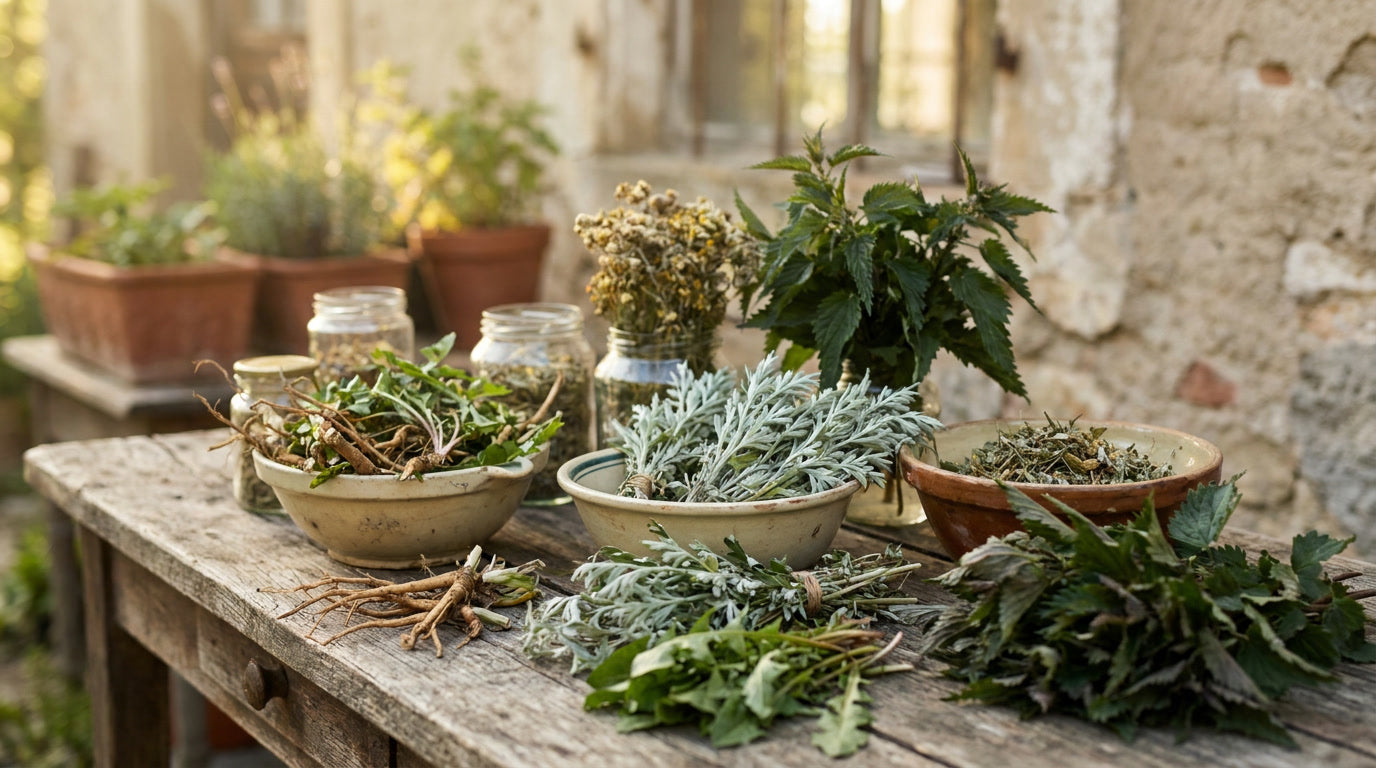
Traditional herbal medicine knows a whole range of herbs used for generations in connection with fluid balance and the elimination of excess fluids. It is not about treating a deficiency or curing a disease—but rather a culturally deeply rooted practice to accompany the body in its own rhythm through natural plant substances. Many of these herbs have been part of the European monastery garden tradition for centuries and passed down from generation to generation. BitterKraft Original
These medicinal herbs are traditionally used to support fluid balance:
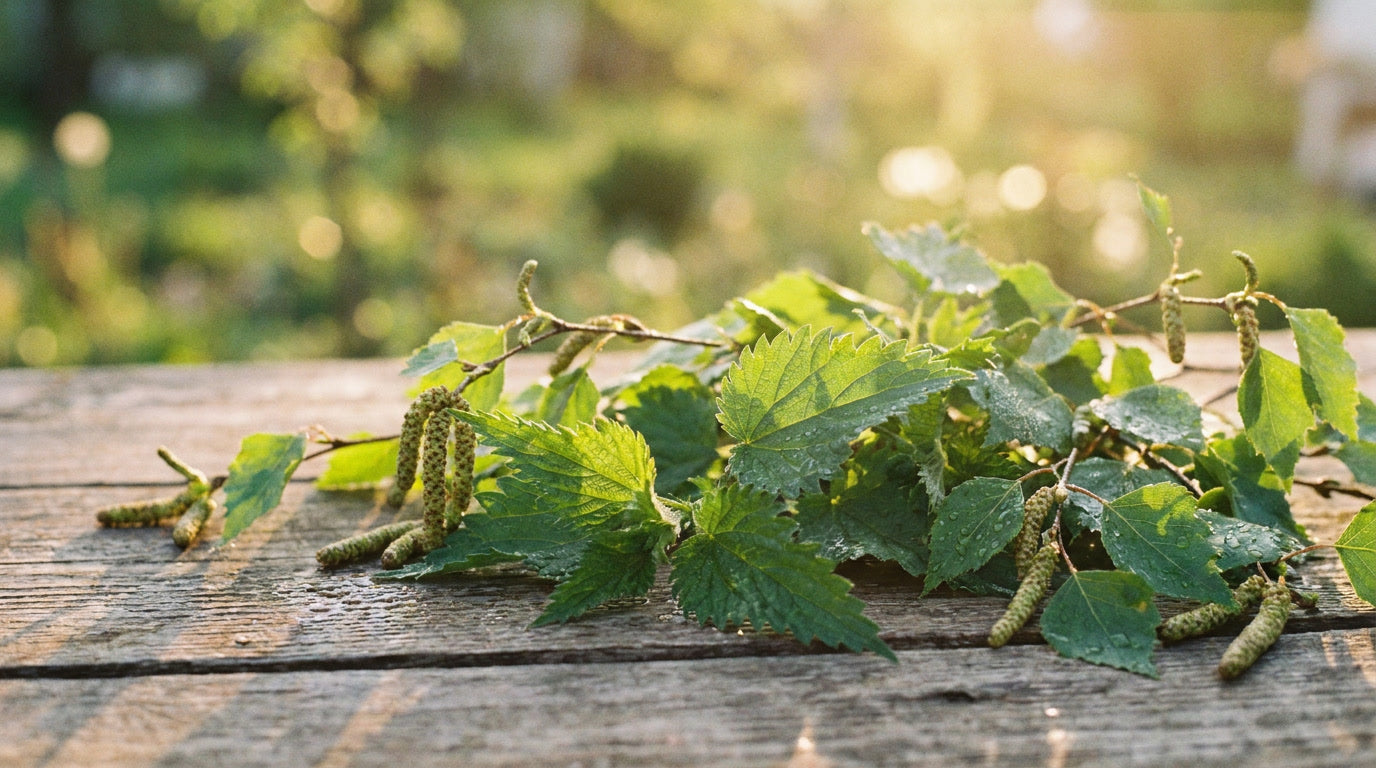
- Nettle (Urtica dioica): Nettle is one of the best-known wild plants in European herbal tradition and has been used traditionally since the Middle Ages. In folk medicine, it is considered a classic “spring herb” to support the body after winter.
- Dandelion (Taraxacum officinale): Dandelion has been known in monastic and folk medicine for centuries and was historically valued both as a leafy vegetable and as a tea ingredient. Traditionally, it symbolizes renewal and the transition to warmer seasons.
- Lovage (Levisticum officinale): Lovage—also called “Maggi herb”—was a staple in medieval monastery gardens and appears in Hildegard’s writings as a valued kitchen herb. Traditionally, it was described as a warming, invigorating plant.
- Parsley (Petroselinum crispum): Parsley is one of the oldest cultivated plants in Europe and was widely used in medieval monastic medicine. It was traditionally used as a strengthening, invigorating green in everyday cooking and herbal preparations.
- Birch leaves (Betula pendula): Birch is considered a symbol of spring and renewal in Nordic and Central European folk medicine. Birch leaf tea has been traditionally used for generations in spring cleanses and is a classic element of European herbal tradition.
- Horsetail (Equisetum arvense): Horsetail—one of the oldest plants on earth—is rich in silica and has long been valued in traditional herbal medicine. Historically, it was part of herbal mixtures used in connection with fluid balance.
- Elderflower (Sambucus nigra): Elderflowers are deeply rooted in European folk medicine and were traditionally used for “mucus congestion” and to support well-being. Prepared as tea or syrup, they are a classic home remedy in herbal medicine.
What’s behind the traditional “diuretic herbs”?
Many of the plants mentioned above contain flavonoids, essential oils, bitter substances, and minerals—secondary plant compounds that give them their characteristic taste and traditional significance. For example, nettle contains potassium, iron, and vitamin C. Dandelion is rich in bitter substances like taraxacin. Horsetail contains high concentrations of silica. These ingredients have been the focus of herbalists’ interest for centuries—not as medicinal drugs, but as part of a living plant culture that enriches daily life.
Especially nice: most of these herbs can be wonderfully integrated into everyday life—as tea, culinary herbs, or as part of herbal broths. Using lovage instead of salt in soup automatically reduces salt content while adding a herb traditionally valued. The same applies to parsley, which serves not only as a garnish but has been deliberately used as an everyday herb since antiquity. Fasting products
Consciously Managing Salt Balance: Practical Approaches for Everyday Life
Those who want to balance their salt intake don’t have to give up everything—it’s more about conscious supplementation and redesign. The first step is often awareness: reading labels, recognizing where sodium is hidden, and gradually adjusting habits. This process can feel unusual at first because many people have calibrated their taste perception so strongly to salt that natural foods initially seem “bland.” But after a few weeks without excessive salt intake, many report perceiving flavors much more distinctly—a sign that the palate adapts.
A particularly elegant strategy from the monastery kitchen is seasoning with herbs as a conscious salt substitute. Lovage, thyme, rosemary, parsley, and marjoram give dishes depth and aroma—without added sodium. Hildegard of Bingen explicitly recommended in her writings to see the kitchen as a space for health care. An herbal broth made from nettle, lovage, and parsley is not only a tasty companion—it is also a ritual of self-care. all Bitterkraft products
Besides using herbs, fluid intake also plays an important role. It may sound paradoxical, but drinking enough supports the body in naturally excreting excess sodium. Herbal teas—especially from nettle, birch leaves, or horsetail—can be a soothing addition. They bring flavor, ritual, and plant ingredients into daily life. Traditional herbal medicine recommends one to three cups daily, ideally spread throughout the day, to give the body continuous opportunity for elimination.
Herbs like lovage, thyme, and parsley can not only replace salt flavor-wise in the kitchen—they also bring a centuries-old tradition of conscious nutrition into everyday life and can enrich overall well-being.
Simple herbal tea blend from the monastic medicine tradition:
✦ 1 part dried nettle leaves
✦ 1 part dried birch leaves
✦ ½ part horsetail
✦ ½ part dandelion leaves
Steep 1–2 teaspoons of the blend in 250 ml hot water for 8–10 minutes, then strain. This blend has been used for generations in European herbal tradition in spring to support inner balance. It is not a medicine but a ritual of enjoyment with a long history.
Movement complements herbal care well: even moderate physical activity like walking, gentle yoga, or swimming stimulates lymph flow and helps the body redistribute fluids. Combined with an herb-rich, salt-reduced diet, this creates a holistic approach that corresponds to the spirit of Hildegard’s medicine: balance through diversity, enjoyment, and conscious living.
Herbs from Your Own Garden – Sustainability and Connection to Nature
There is hardly anything more satisfying than growing your own herbs and then using them consciously. Growing nettle, parsley, lovage, and dandelion is very easy—many of these plants grow wild in gardens or meadows anyway. Those with a balcony or small bed can easily create a small “pharmacy” designed in the spirit of medieval monastery gardens. Hildegard explicitly described in her works how important the direct relationship to the plant is—the picking, smelling, and processing as part of a holistic healing process.
Those without a garden or who rely on reliably dried quality find a good alternative in high-quality organic herbal blends. Hildegard of Bingen products It is important to pay attention to quality: herbs that are gently dried and processed without chemical additives contain significantly more of the characteristic secondary plant compounds. The Bitterkraft range includes various herbal products composed according to traditional principles, translating the idea of monastic medicine into modern everyday life.
Perhaps the most important aspect of growing and using herbs, however, is the one you cannot buy: the connection to nature and awareness of what you give your body. Those who pick fresh nettle leaves in the morning, add lovage to soup at noon, and drink a cup of birch leaf tea in the evening live not only with less salt—they live more consciously. And that is the heart of Hildegard’s philosophy: health as an attitude, not a program. Fasting products
A review on the history of European herbal medicine (Müller-Ebeling et al., Herbal Medicine in the Middle Ages, 2003) points out that monastery gardens of the High Middle Ages systematically cultivated plants associated in folk belief with elimination and cleansing—including nettle, birch, and dandelion. These plants were not considered medicines but part of a holistic lifestyle.
Sustainability and connection to nature go hand in hand. Those who gather wild herbs like nettle and dandelion themselves also ensure that these plants—often dismissed as “weeds”—receive their deserved appreciation. Monastic medicine never distinguished between “useful” and “useless” plants: every plant had its role, its place in the great balance of nature. This attitude is more relevant today than ever—not only for your own salt balance but for your relationship with the earth as a whole.


Leave a comment
This site is protected by hCaptcha and the hCaptcha Privacy Policy and Terms of Service apply.